
Connectivity Is Becoming Travel’s Most Critical Trust Signal


Skift Take
Connectivity has become a foundational layer of the travel experience. As the smartphone becomes the control point for travel, reliable connection is becoming less about convenience and more about trust.

This sponsored content was created in collaboration with a Skift partner.
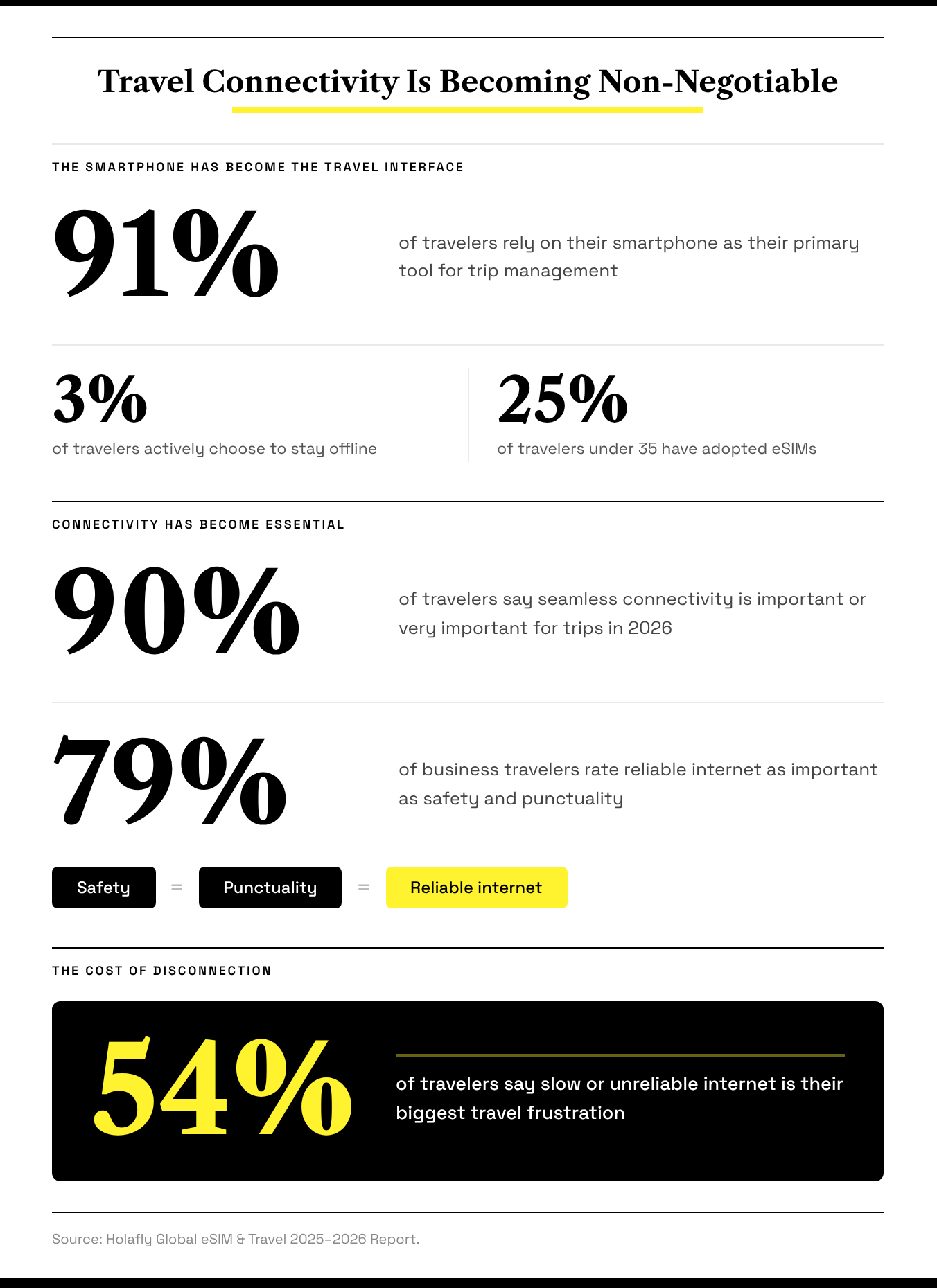
Travelers have a short list of things they consider non-negotiable on a trip. According to Holafly’s Global eSIM & Travel 2025-2026 report, mobile connectivity has moved to the top. Nine in 10 travelers say seamless connectivity is important or very important for trips in 2026, and 79% of business travelers now rate a reliable internet connection on par with safety and punctuality, ahead of nearly every amenity the travel industry has built its loyalty and experience programs around.
But the numbers obscure a category change. The thing travelers call “connectivity” is no longer the thing the industry has been selling under that name.
Connectivity is measurable. It can be defined in terms of data allowances, coverage maps, and speeds. Connectedness is harder to quantify. It shows up in moments: when a traveler lands and can orient themselves immediately, when plans change and alternatives are accessible, or when communication remains uninterrupted across time zones. It’s an emotional infrastructure. What travelers ultimately want is the ability to navigate uncertainty without disruption and stay in control when circumstances change.
“Travelers aren’t simply buying data. They’re also buying peace of mind, continuity, and autonomy,” said Daniela Prado, brand director at Holafly. “We’re constantly connected in our everyday lives, and that expectation doesn’t disappear when we’re on a trip. In fact, it becomes even more critical.”
The Smartphone Has Become the Travel Interface
The old model of a pre-planned itinerary, printed confirmations, and local help at every stage no longer works in a world of mobile-first travel. People now decide in real time. They search as they go, book, cancel, reroute, translate, pay, work, and share from the same device.
According to the Holafly report, 91% of travelers rely on their smartphones as their primary tool for trip management, and only 3% actively choose to stay offline — a near-universal expectation of access. At the same time, eSIM adoption has already reached 25% among travelers under 35.
Nearly half of international trips are now to first-time destinations, which means travelers have less local knowledge and a greater need for live access to maps, recommendations, transport, and services.
But a hotel confirmation is only useful if it can be retrieved. A digital boarding pass only works if it loads. A ride-hailing app only matters if the traveler can open it outside the terminal. Mobile connectivity has graduated from a back-office concern to the infrastructure layer holding the trip together.
Disconnection Has Become a Trust Problem
The first consequence of a failed connection is often psychological.
“Slow or unreliable internet is already the number one frustration for over 54% of travelers, but the real consequence goes beyond inconvenience,” said Prado. “It creates anxiety, loss of control, and a breakdown in trust. When your phone is your map, your wallet, your communication tool, and your safety net, connectivity becomes foundational infrastructure.”
Travel has always involved uncertainty. Flights are delayed, plans change, the weather turns, and meetings move. The difference now is that travelers expect to manage much of that uncertainty digitally. Connectivity has become the means by which they recover from disruption.
A fast connection that disappears at a border crossing, during a layover, or upon arrival does not deliver what travelers now need. The benchmark is shifting from performance in ideal conditions to resilience in unpredictable ones.
“Younger travelers have higher levels of digital reliance, which makes disruptions more frequent and impactful in their daily behavior,” said Prado. “Older travelers prioritize stability and predictability, so reliability becomes a key driver of trust. Delivering continuity at scale, therefore, is about eliminating friction across all user segments.”
Travel Connectivity Needs a Safety Net
If travelers now evaluate connectivity by reliability, then providers competing on gigabytes are competing on the wrong axis. Selling data falls short when the traveler’s actual expectation is continuity.
Most connectivity products are still priced and provisioned against the plan. The trip the traveler bought, the destination they specified, or the dates they confirmed. However, travel is the category in which the plan is least likely to hold.
Holafly’s recently introduced Always On benefit is built around that gap. It gives travelers a backup layer with one gigabyte of additional data per month at no extra cost across more than 70 destinations, on top of the company’s existing eSIM coverage in over 200.
“A traveler might buy an eSIM for a one-week trip to Europe, but it now comes with a built-in backup of additional data across over 70 destinations, acting as a safety net that activates automatically,” said Prado. “If a layover routes through a country that wasn’t in the plan, or a flight delay turns one week into two, they’re still covered.”
The value is not in the extra data itself, but in the reassurance it provides.
“The current model of connectivity is still built around limits, and on the assumption that everything will work as expected,” said Prado. “However, travel is unpredictable, and unexpected situations happen, often at the exact moment when you need connectivity the most. Always On is designed to remove that uncertainty.”
The Next Standard Is Continuous Connection
The connected travel experience is moving toward something travelers will think about less, not more. That may sound counterintuitive, but it’s how infrastructure tends to mature. The better it works, the more invisible it becomes.
According to Prado, the future of travel connectivity will no longer be something travelers plan for, but something they assume, like electricity in a hotel room.
This exposes an industry gap. Airlines, hotels, and travel platforms continue to optimize the physical experience while underinvesting in the digital layer that now holds the trip together. When the digital layer fails, many of those improvements are harder to use or invisible altogether.
“Travelers are already selecting destinations based on factors such as network reliability and emergency connectivity,” said Prado. “At the same time, the impact of failure is becoming more visible. Negative digital experiences are amplified on social platforms, shaping perceptions at scale and affecting the attractiveness of entire destinations.”
This does not mean every travel brand needs to become a connectivity provider. It does mean they need to recognize how much of their own experience depends on the traveler staying online. Mobile keys, flight alerts, loyalty benefits, rideshare partnerships, live concierge tools, digital payments, and access to travel-related apps all assume connection. When that assumption fails, the brand experience weakens with it.
For travelers, connectivity is no longer a trip add-on. It is the layer that makes the rest of the trip work — and increasingly, it’s the trust signal that determines whether the experience feels seamless, supported, and worth repeating.
To learn more about Holafly, visit esim.holafly.com
This content was created collaboratively by Holafly and Skift Studio.
