
Airlines in 2026: Flying into Trouble, or Still Holding Altitude?

Skift Take
As the airline industry looks toward 2026, one thing is clear from our recent Skift and Airline Weekly webinar: the story is far more complicated than a simple boom or bust narrative.

Financially, many carriers are still performing well. Yet the foundations of that strength look more uneven than they have in years. Our recent Skift and Airline Weekly webinar, “Airlines in 2026: Flying into Trouble?”, set out what is really happening and what to watch next.
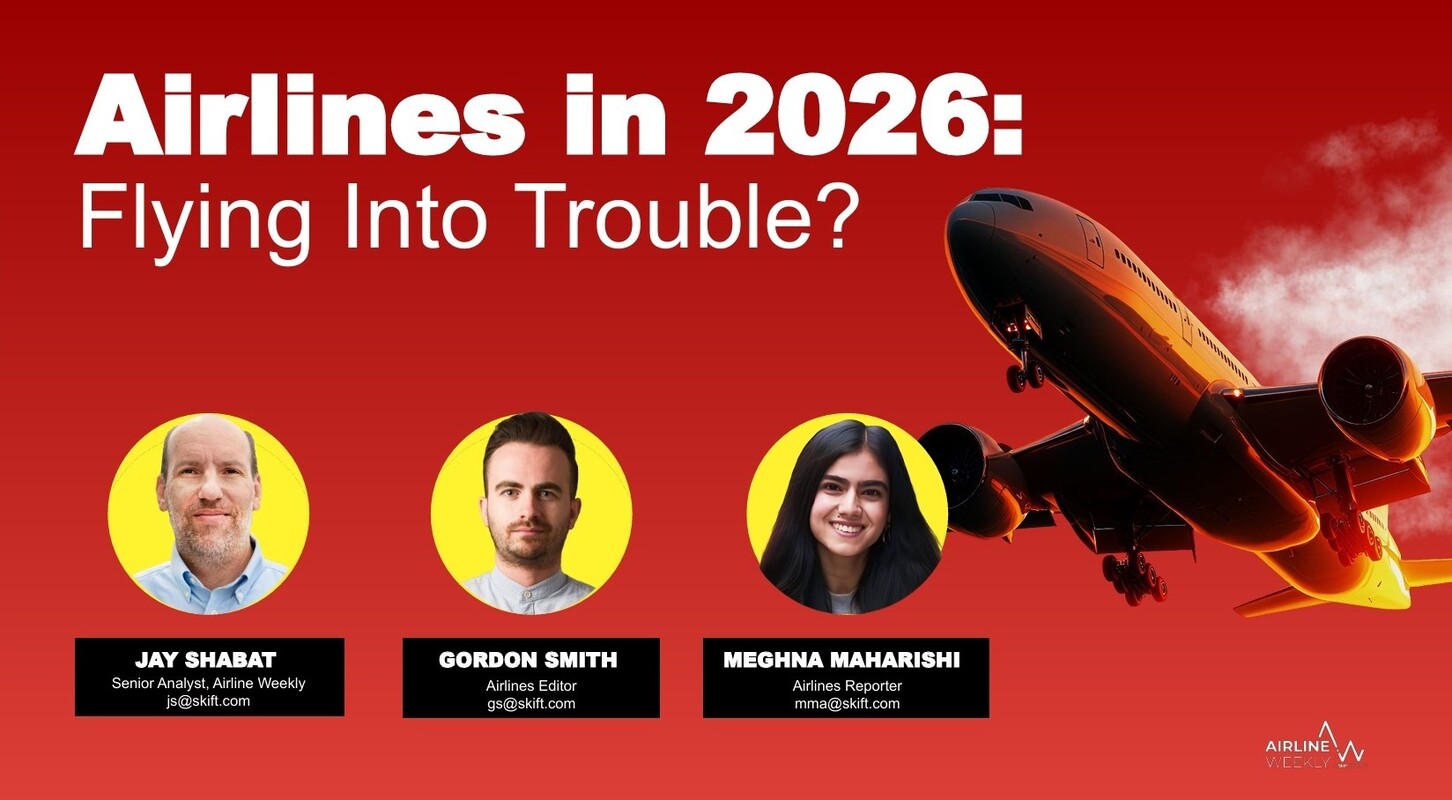
Here is what Skift Airline Weekly Senior Analyst Jay Shabat, Skift Airlines Editor Gordon Smith, and Skift Airline Reporter Meghna Maharishi unpacked during our conversation, and how it sets the stage for Skift Aviation Forum in Fort Worth on December 3.
From “Years From Hell” to Record Profits
Jay began with a quick look back.
- 2020 and 2021 were “the years from hell” for airlines, with demand collapsing.
- From 2022 through 2025, the story has been recovery-driven by strong demand, especially in premium cabins, across many regions.
- At the same time, the industry has dealt with supply constraints caused by production delays, engine issues, and bottlenecks in aircraft interiors and parts.
- Fuel prices have been relatively benign, while non-fuel costs such as labor rose sharply in the post-pandemic period before starting to moderate in some markets.
Using IATA data, Jay noted that 2023 and 2024 were among the best years in airline industry history in terms of aggregate operating profits.
2025: A Bifurcated Travel Economy
Meghna focused on 2025 as the jumping-off point for 2026. The headline: It has been a rebound year for airlines, but not for every customer segment.
A resilient top end, softer economy cabins
- Airlines have seen very strong premium demand, which has been central to profitability.
- In contrast, economy demand has weakened in the United States and for some European carriers, especially for main cabin fares from American travelers.
- This reflects a bifurcated economy: wealthier travelers continue to spend on business and first class and on long-haul leisure, while more price-sensitive travelers pull back.
Tariffs, geopolitics, and safety in the spotlight
Several developments in 2025 could still shape 2026:
- Tariffs introduced in the spring hit consumer confidence and briefly stalled business travel before premium demand recovered at many legacy carriers.
- Geopolitical tensions, especially in the Middle East, led to intermittent suspensions of service by Western airlines before stabilizing more recently.
- Air safety concerns: Two fatal crashes, one in Washington, DC, and one involving Air India in the summer, set off renewed public scrutiny.
- In the United States, attention has been focused on the air traffic controller shortage and aging infrastructure, issues that became even more visible during the recent government shutdown, which caused staffing problems at airports and disrupted travel.
- Labor unrest has been significant, with a major flight attendant strike at Air Canada, a pilot strike at LATAM, and ongoing contract talks with U.S. flight attendant unions that could affect future labor costs.
The Optimistic Case for Airlines in 2026
Despite the risks, Jay outlined several reasons airlines may continue to perform well in 2026.
- Fuel prices remain relatively low by historical standards, which is critical given fuel’s share of airline costs.
- Airlines report no clear sign yet of weakening premium demand, after several years of strength.
- Global growth projections for 2026 do not point to a broad recession, and some aviation-intensive markets, including India and parts of the Gulf and Africa, are expected to grow faster than the global average.
- New aircraft such as A320neos, 737 MAXs, 787s, and A350s continue to enter fleets and improve unit costs.
- Supply constraints in aircraft and engines are expected to continue for several years, limiting capacity growth and supporting yields.
- Consolidation activity remains active worldwide, which historically has often supported capacity discipline and pricing.
The Risks that Could Spoil the Party
Meghna then laid out the other side of the ledger.
- U.S. immigration policies and reports of tougher experiences at the border have already contributed to softer inbound demand from some markets, as noted by carriers such as Turkish Airlines and KLM.
- Tariffs and a weaker U.S. dollar raise questions about how long premium travelers will continue spending at current levels, particularly on international trips where their money buys less.
- Parts of the U.S. economy are slowing, and some consumers have already reduced discretionary spending.
- The premium boom itself may be more cyclical than structural. Airlines are investing heavily in premium products and loyalty, but it is not yet clear how those bets will perform if economic conditions worsen.
Regions and Segments to Watch
The discussion highlighted several areas to monitor into 2026:
- U.S. low-cost carriers such as Southwest, JetBlue, Frontier, and Spirit have struggled relative to many peers and are pursuing turnaround strategies that will be tested over the next year.
- Growth is likely to be strongest in markets such as India, parts of Southeast Asia, and the Gulf and Middle East, supported by economic growth, tourism investment, and fleet expansion.
- Loyalty and co-branded credit cards are playing a growing role in airline strategy, influencing everything from network planning to product design, especially in the United States.
So, Are Airlines Flying into Trouble in 2026?
Asked to sum up 2026 in a phrase, Meghna called it a “wait and watch” year. The premium segment, tariff effects, political risks, and economic backdrop all remain in flux.
Jay highlighted the central unknown: whether the premium boom continues to underpin industry resilience, or whether it finally shows signs of strain.
These are exactly the issues we will explore further at Skift Aviation Forum in Fort Worth on December 3, alongside CEOs and senior leaders from airlines including American, United, Southwest, Alaska, Air Canada, Porter, Breeze, JetBlue, and more.
Check out the full agenda and join the discussion on what 2026 will really look like for airlines. Limited seats remain. Get your tickets today.
Get Your Tickets
Full-price tickets are $995 (Solo) and $945 (Group). Secure checkout with Visa • MasterCard • Amex • PayPal • Google Pay • Apple Pay 📩 Need an invoice? Email events@skift.com.
1 Person
Solo Ticket
$995
2-6 People
Group Ticket
From
$945
