HotelMe attracts $3M in funding and USA Today as partner for unique hotel review site
Skift Take

HotelMe's authenticated hotel review proposition is one of those things that may you wonder why no one has done it until now. The startup is very late to the hotel-review game, but it has a powerful marketing partner in USA Today.

-Dennis Schaal

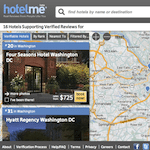
USA Today and parent company Gannett partnered with HotelMe to soft launch a hotel review site that takes a novel twist to the fake review issue: Two dozen hotel brands have signed on to verify whether review writers actually stayed at the property regardless of how or where they booked the room.

Hotel industry veteran Trip Schneck, who co-founded the site and District Hospitality Partners with Frederic Malek, says HotelMe has attracted $3 million in seed funding from Thayer Ventures, USA Today, the founders and other angels.

Media giant USA Today, which has committed to integrating HotelMe into USA Today Travel and to promote the joint venture through paid and in-kind marketing, has a minority stake in the enterprise and will handle ad sales, Schneck says.

Hotel brands participating in the patent-pending verification process, which would lead to either “RealStay” or unverified review designations, range from Hyatt and Best Western, to La Quinta, Four Seasons, and Radisson.

Although Hyatt is a co-founder of Room Key, the new hotel-booking site founded by major hotel chains, notably absent from the HotelMe partnership roster at this early stage are the other Room Key founders, including Choice Hotels, Hilton, InterContinental Hotel Group, Wyndham, and Marriott.

However, Schneck says a couple of these brands could be coming on board shortly, and HotelMe has had discussions with Room Key about providing search functionality to HotelMe.

New slant on user reviews

HotelMe, which is in beta, is geared to attack the fake review problem as it cites unnamed “industry experts and researchers” who argue that more than 40% of user reviews are fakes. That statistic, though, is open to debate.

“It’s only going to get worse in terms of fictitious reviews and we think we have a pretty good solution to that problem,” Schneck says.

The two most prevalent approaches to user-generated content are typified by hotel-review leader TripAdvisor, which has collected more than 75 million reviews and opinions, and doesn’t require verified hotel stays, and online travel agency sites such as Booking.com and Expedia, which mandate that users book stays on their sites before posting reviews.

The OTA approach limits the ability to scale, and TripAdvisor’s tack, which it shows no compunction to abandon because of all the consequent SEO juice and engagement for advertisers, sacrifices some authenticity.

HotelMe states that for a review to be trumpeted as a RealStay on its site the “hotel or brand being reviewed must join our authentication platform (patent pending) and confirm that the reviewer actually stayed at a particular location. We offer this process as an unbiased service to all willing hospitality participants.”

It isn’t a matter of someone at HotelMe phoning a hotel chain or property to find out if a guest really stayed there.

Schneck says the process is automated through APIs, with review writers entering their names, the property and the approximate date they stayed there, and the hotel providing corroboration or lack thereof.

The fake review question is a hotly debate issue in travel industry circles. The extent to which hotel guests are aware of or care about the problem is another question.

Destinations guides and bookings on hotel sites

In addition to displaying verified and unverified user reviews, HotelMe offers hotel information and photos, rankings, user-written guides to local restaurants and points of interest, and the ability to book stays on hotel websites.

Schneck says HotelMe is geared to be more hotel friendly than most review sites as bookings take place on hotel websites rather than through online travel agencies.

HotelMe, which currently accesses about 110,000 properties, primarily in North America, sources its hotel listings information from Alliance and Google Places, Schneck says. Brands representing about 10,000 hotels have agreed to verify reviews.

Like all startups, HotelMe’s challenge will be to build the still-sparse content, scale the user base, and attract major partners, in this case hotel chains.

Having the marketing clout of USA Today and Gannett certainly won’t hurt, as HotelMe will be marketed in print and online.

On the content-building question, many of the hotels displayed, even those from partner chains, have no hotel reviews, verified or unverified, associated with them on the site.

In its first baby steps toward getting off the ground on that front, HotelMe’s soft launch kicked off September 17 with a sweepstakes designed to spur hotel guests to get into review-writing mode.

Schneck says the site, which is a year-and-a-half in the making, is focusing on building its review content to get critical mass, and has other features ready to go in the near future.

Says Schneck: “Our goal is not just to build authenticated reviews, but also to offer like-minded reviews to like-minded individuals.”

Disclosure: The author writes the Digital Traveler column for USA Today.


Tags:
  • http://twitter.com/OleryHQ Olery

    Wonder how HotelMe will deal with hotels that do not verify reviews from guests of whom they know they left their hotel dissatisfied.

  • http://twitter.com/SkooshKarma Skoosh Karma

    Agreed with Olery… that could be a major issue. Will there be any transparency here, and how will any challenges between hotel & guest be dealt with??

    Also, this feels like another example of a website created by the industry to solve a problem for those within the industry, rather than the consumers themselves – a bit like RoomKey itself, and indeed Kayak has an air of that too.
    That’s not to say it won’t be successful – with all that money behind it there’s no doubt that it better be – but it feels like another example of the travel industry protecting its own interests, a rather defensive move. There’s no real sign of the most important stakeholder – the consumer – being a main figure in the thinking behind this site.
    Funnily enough, this is actually where OTAs acting as middlemen between hotels and guests have a huge advantage over everyone else as they can both validate a guest who stayed at a hotel and do so without any massive loyalty to the hotel.

  • http://twitter.com/dcraig Daniel Edward Craig

    For the system to work it must gain mass credibility with consumers. Will it be interfaced with hotel PMS systems to automatically verify whether or not a guest stayed? If not hotels that are gaming the system now will continue to game the system by confirming that fictional guests who wrote fake reviews stayed there and by denying that guests who wrote bad reviews stayed. An interface could bring up privacy issues, however – not to mention control issues.

  • Trip Schneck

    Daniel, Skoosh, and Olery – All great comments, everyone here at Hotelme appreciates the feedback. We created Hotelme for both the consumer and the hotel industry. Our view was that the current hotel review model was broken and it was doing a disservice to both consumers and hotels. For consumers, it is becoming increasingly difficult to rely on user reviews due to the amount of fictitious reviews and gaming of the system. Consumers are using reviews that are often misleading to help make travel planning decisions. Whether they are inflated reviews written by the hotel’s PR company or the hotel proprietor themselves, at the end of the day, consumers are being duped. As it relates to the hotel industry, the majority of websites that offer hotel reviews are high cost third party intermediaries. As such, the reservation traffic is directed to high cost of sale distribution channels.

    Our aim is to change the model for consumers, by offering up verified reviews from guests that have actually stayed at the hotel they are reviewing, allowing them to make more informed decisions around their travel planning. For hotels, we want to offer up a direct distribution source by sending all reservation inquiries back to their lowest cost customer acquisition channel, brand.com. This should also favor the consumer as most brands now offer the lowest available rate on their brand.com site.

    Technically, the patent pending verification process is done through an API with either the CRS, PMS, or CRM database. We are not pulling any customer data from those sources, we are simply sending the information the reviewer gives us and asking the hotel if there is a match (last name, dates of stay). The hotel is not able to verify the review based on how the review reads. They do not see the review until after the authentication process has occurred. This is obviously to prevent hotels from verifying only positive reviews. While there are some OTAs that offer verified reviews on their site, they can only verify reviews from people that booked on their site. Our site allows for authentication regardless of reservation source.

    We are still in the early stages of our site and have many more features that will be rolled out in the coming weeks. Our product road map is lengthy, but has been architectured with the consumer top of mind. We are a community site and our first allegiance is to the traveling consumer. Again, we appreciate all of the feedback.

  • http://twitter.com/OleryHQ Olery

    The connections with hotel’s CRS/PMS/CRM databases sound promising. We wish you good luck.

  • http://twitter.com/aaronturney Aaron Turney

    Couldn’t be more true. The only way to combat hotels confirming fake reservations and writing fake reviews as well as denying true negative reviews would be a reporting model like STR. Hotels could provide name, stay dates and booking source to get around providing more detailed information. But would guests have to opt in to this program for the sake of privacy issues?

  • http://www.facebook.com/profile.php?id=707976432 Dennis Schaal

    Trip: Thanks for your comments. Interesting point re. the details on how the technology works for the verification process. Also, interesting point on how most hotel reviews hosted on higher-cost distribution channels, and HotelMe could level the playing field a bit.

  • Mike Smith

    The biggest challenge is with hotels that are not a major brandslike the chains mentioned in the article. How does hotelme solve that problem?

Subscribe to a daily dose of news from Skift