
Skift Take
If US Airways and American Airlines merge and they don't heed the lessons of past blunders, then the integration process could set back the new American Airlines for years, new logo and livery or not.

Get ready for a possibly painful, problem-ridden, and prolonged merger of American Airlines and US Airways if the deal goes through.
But, some could argue that on the positive side, at least the paint job and uniform issues likely have been settled.
The integration of the two airlines, with all of the labor, technological and logistical issues to sort out, will undoubtedly take years, and the stakes are extremely high, as United-Continental’s bumpy track record in their merger highlights.
Getting a handle on integrating US Airways’ and American Airlines’ pilots, flight attendants and other labor groups will be an overriding issue, as former American CEO Robert Crandall and numerous analysts point out.
Pilot deal could ease some of the pain
Although the details aren’t publicly known, the pilots unions at American and US Airways have made significant progress toward a framework if their respective boards seal the deal.
The potential complications are exacerbated, however, because at US Airways itself, two pilots groups still exist, a legacy of the 2005 AmericaWest-US Airways merger, so there has been a lack of a true melding more than seven years after that acquisition.
“US Airways and America West pilots still aren’t integrated, almost a decade later,” says Scott Hamilton, managing director of aviation-consulting firm Leeham Co. “Pissed-off employees can screw up a merger for years. See Texas Air Corp. as the worst example.”
A big job without reservation
In early March 2012, United abandoned its decades-old Apollo reservations system and migrated to HP’s SHARES platform, which had been handling Continental for years. Four months later, in July, United’s flights notched just a 64.1% on-time arrival rate in as problems persisted with the reservations systems transition, although United recently seems to have moved past the worst of it.
The problems have been so acute that United CEO Jeff Smisek recently made a plea for straying business travelers to return to the airline.
That serves as a warning to the management of a merged American Airlines-US Airways: a botched merger can alienate your most important customers and really screw up the bottom line for a long time to come.
The relatively problem-free Delta-Northwest merger and migration may serve as a case study for American and US Airways to emulate, in some respects, at least.
Delta moved the Northwest PARS reservations system to Deltamatic, both of which were operated by Travelport’s Worldspan unit, at the end of January 2010, and there is now a single revenue management system for the combined airlines.
Beyond the nuts and bolts of getting the technology right, Delta did a great job of retaining key people from Northwest and sharing best-practices and procedures across both airlines, says Henry Harteveldt, travel industry analyst at Hudson Crossing.
On the other hand, Continental ran the show in the United-Continental merger, and was dismissive of a lot of what United was doing, including its Economy Plus seats, which the merged United eventually adopted.
“There was a huge amount of arrogance on the part of Continental Airlines,” Harteveldt says.
A little from column A, a little from column B
American Airlines is by far the larger of the two airlines, but US Airways has been the more profitable and scrappy carrier. All signs point toward Doug Parker and Scott Kirby, US Airways CEO and president, respectively, heading the new American Airlines, with a role for current American Airlines CEO Tom Horton likely a sticking point and being negotiated.
Some reports have speculated that Horton may emerge as the chairman of the merged airline.
US Airways currently runs on the HP SHARES reservation system, the same basic system that United uses, and it’s likely in the event of a merger that US Airways would migrate to SabreSonic, which hosts American Airlines’ reservations. Before it merged with AmericaWest in 2005, US Airways used Sabre so this would be a homecoming of sorts.
Parker and Kirby, if they are heading the combined American Airlines-US Airways, would be wise to take the best of from US Airways, including their skills in turning a profit, and also take advantage of American’s superior attributes, including technology infrastructure and marketing prowess.
Harteveldt believes that the merger of the two airlines could take up to four years to complete after the transaction closes.
Hamilton of Leeham Co. recalls that both US Airways and American have experience in mergers, although American “screwed up” mergers with Reno Air (1999) and TWA (2001).
Those blunders, coupled with American’s decision not to file for bankruptcy right after September 11, 2001, as competitors did, “have fueled labor discord among pilots and flight attendants to this day,” Hamilton argues.
Says Hamilton: “US Airways has been through this before and so has American so hopefully there should be lessons learned.”
That’s if the much-hyped merger becomes a reality.
The Daily Newsletter
Our daily coverage of the global travel industry. Written by editors and analysts from across Skift’s brands.
Have a confidential tip for Skift? Get in touch
Tags: american airlines, us airways
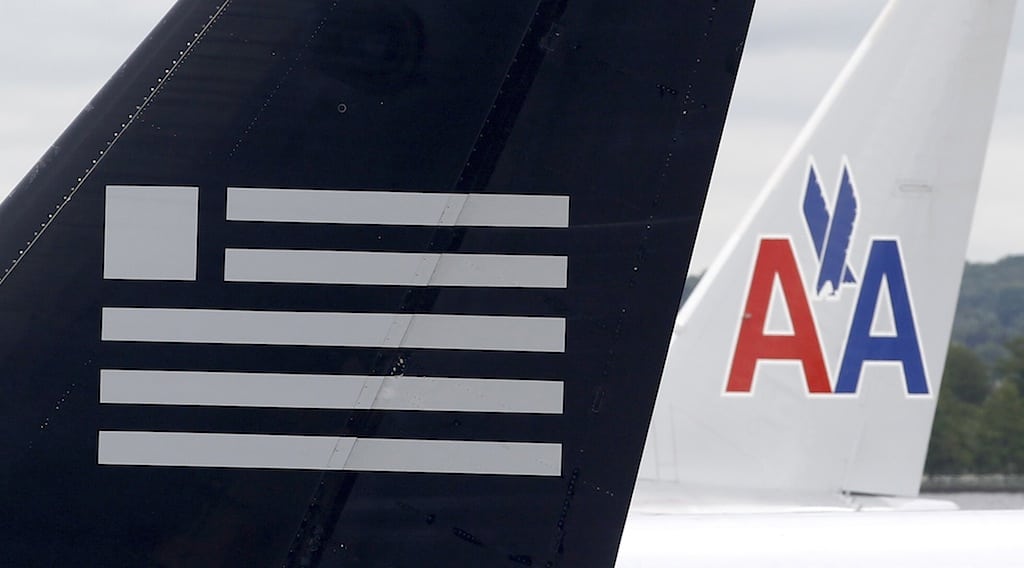
Photo credit: A US Airways plane and an American Airlines plane share a terminal at Ronald Reagan National Airport in Washington April 23, 2012. Kevin Lamarque / Reuters